How to choose a Veterinary X-ray Generator for Small Animal Practice

How to choose a Veterinary X-ray Generator for Small Animal Practice
Apr. 09, 2026
Katie Wright
Read Time: 5 minutes
Read Time: 5 minutes
When it comes to X-ray generators, there are an overwhelming number of options on the market that can make choosing the right one feel like a bit daunting. In this guide, we break down the key form factors and technologies that go into a generator, and explain the practical value of each, so you can make a confident and informed decision for your practice.
Output: How much power do I need?
Generator output is typically expressed in two ways: kilowatts (e.g. 2.4kW) and maximum exposure settings as a kVp/mA rating (e.g. 100/40). It's worth noting that a maximum kVp/mA rating doesn't guarantee you can use both values simultaneously and you may need to reduce kV to achieve maximum mA, or vice versa. Kilowatts give a useful indication of relative power output, while maximum exposure settings are often more relevant to day-to-day clinical use.
A 1.3kW 90/20 generator sits at the lower end of the power range but could serve a feline-only practice well. A 2.4kW 100/40 generator will cover the majority of patients in small animal practice, though larger patients can still present a challenge, and longer exposure times increase the risk of motion blur, which can be a real frustration in a busy clinical setting.
Higher-powered generators, typically found in fixed systems such as a 32kW 125/500 unit, offer greater peak kV for improved tissue penetration, making imaging larger patients considerably more straightforward. Their higher peak mA also means equivalent exposures can be delivered in a shorter timeframe, which is a meaningful advantage when motion blur is a concern.
The principle is simple: more output gives you more clinical flexibility. For most practices, investing in a generator with higher output than you think you need today is a decision you're unlikely to regret.
Static vs Rotating Anode
Without going too deep into the physics, the anode (positive electrode) is where electrons, having left the cathode (negative electrode), strike to generate X-ray photons. The specific point of impact is known as the focal spot.
There are two types of anode you'll encounter: static and rotating. Static anodes are typically found in portable and lower-powered generators; rotating anodes in higher-powered systems.
The key difference comes down to heat management. The electrons striking the anode generate a significant amount of waste heat, a rotating anode dissipates this more effectively, resulting in a longer tube life. For practices with high imaging volumes, this is a practical consideration worth factoring into your decision.
Focal Spot Size
Some generator specifications will list a focal spot size, and certain systems even allow you to select between two options. As a general rule, smaller is considered preferable, though with some important caveats.
A smaller focal spot delivers better spatial resolution, while a larger focal spot is more effective when shorter exposure times are needed. The trade-off is that a smaller focal spot concentrates more energy, and therefore more heat, in a single point.
In practice, the difference between focal spot sizes is subtle and unlikely to be noticeable unless you are specifically looking for it. For most clinical users, a higher maximum output will deliver greater day-to-day benefit than a marginally smaller focal spot.
Fixed
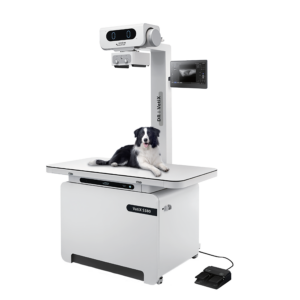
Mindray Vetix S300 integrated X-ray system
Fixed systems consist of an X-ray tube mounted on a column, attached to a floating top table with a bucky tray for a CR or DR plate, or with an integrated DR panel included. A fully integrated system, where a single workstation controls both the generator and DR panel, represents the optimal setup for speed and clinical workflow. These systems have historically carried a significant price premium, but costs have reduced considerably in recent years, making high-quality fixed solutions genuinely accessible for first-opinion practice.
The column may be fixed or height-adjustable, allowing the X-ray tube to be repositioned to change the Fixed Focal Distance (FFD) for views taken with the plate in the bucky or on the table top. In specialist environments, the generator column can be rail-mounted with an angulating tube head to accommodate views requiring a horizontal beam. Fixed generators typically pair with a floating top table, which makes patient positioning significantly easier than working with a static surface. Tertiary referral hospitals may choose a bespoke X-ray room with ceiling or gantry-mounted equipment for the greatest flexibility.
Mobile
Fuji FDR Nano mobile X-ray system
Mobile units combine a generator and DR system into a single wheeled platform, controlled from one integrated screen. They are a relatively specialist choice in veterinary practice but come into their own where imaging is required across multiple rooms or in intraoperative settings. They are most commonly found in referral hospital environments.
Portable
Mindray VetiPad M1
Portable X-ray systems have come a long way, and today's solutions offer a compelling combination of flexibility, image quality and clinical capability that makes them a genuinely strong choice for a wide range of practices. While portable generators do sit at the lower end of the output range due to their size, and must be mounted appropriately on a wall arm or floating top table rather than hand-held during exposure, the digital detector technology that pairs with them has advanced significantly.
A strong example is the Mindray VetiPad M1 and VetiPad M1 Plus, both of which Probo Medical now supplies. These lightweight, portable DR panels deliver high-quality digital imaging with rapid processing times, making accurate diagnostics achievable across a wide variety of clinical settings. The M1 measures 14" x 17" while the M1 Plus offers a larger 17" x 17" format, both well suited to animals of different sizes. With a DQE of 70%, both panels produce superior images at lower radiation doses, and their IP54 dustproof and waterproof rating makes them genuinely practical in the realities of a veterinary environment.
What sets these panels apart is the veterinary-specific software built in as standard. Both include iShotHelper for precise patient positioning guidance, iMeasure for cardiac and orthopaedic measurement tools (including VHS, TPLO, HD, RLAD and VLAS calculations), and image stitching for long bone studies. These are not afterthoughts, they are the same tools found in Mindray's fully integrated VetiX S300 fixed system, brought into a portable format.
Crucially, both panels can be retrofitted to an existing table and generator, meaning practices can upgrade to DR quality imaging without replacing their entire system. For practices looking for an affordable entry into digital radiography, or those needing flexible imaging capability across multiple spaces, the VetiPad M1 and M1 Plus represent an excellent and practical solution.
Contact Us Today
Choosing the right X-ray system for your practice is an important decision, and our team is here to assist you. Whether you're equipping a new practice or upgrading existing equipment, we're happy to talk through your requirements and recommend the best solution for your needs.
Get in touch with Probo Medical today via our website to find out more.