When the dental department at a hospital in Weston-Super-Mare needed to replace its ageing Villa Rotograph Evo panoramic unit, the team turned to Probo Medical to manage the transition. What followed was a straightforward, well-coordinated project that left the department with a significantly more capable imaging system and minimal disruption to clinical operations.
The Rotograph Evo had served the hospital well. As a 2D panoramic-only system, it offered reliable diagnostic imaging for standard assessments, a range of pre-programmed projections including panoramic, TMJ and sinus views, and a touch-screen interface that made it accessible for everyday use. For many years it was a dependable and reliable system for routine care. But clinical demands evolve, and what was once sufficient for general dental assessment is increasingly falling short in departments that are expected to support implant planning, surgical referrals, and more complex diagnostic workflows.
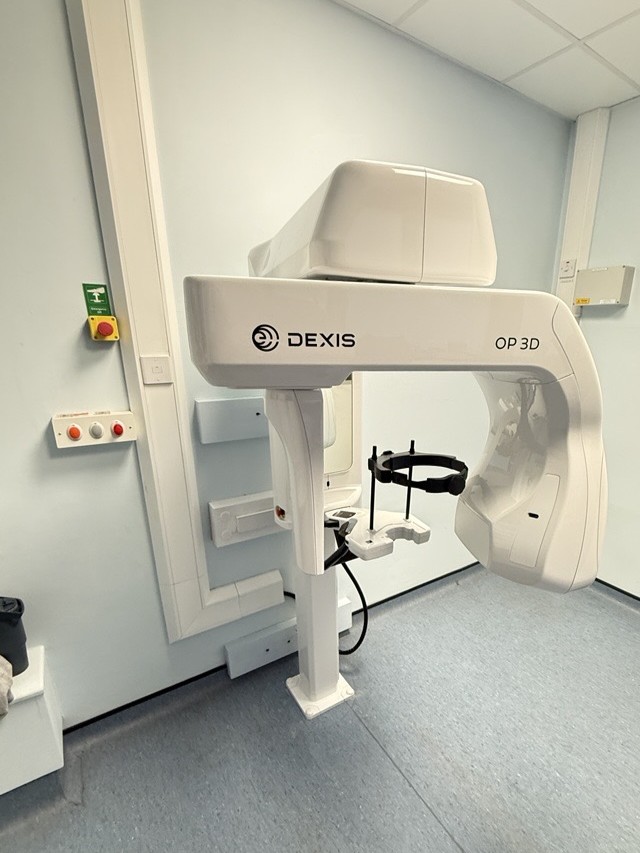
The replacement of choice was the DEXIS OP 3D, a multimodality extraoral imaging platform that delivers 2D panoramic, cephalometric, and 3D CBCT imaging within a single system. Where the Rotograph Evo was limited to flat 2D images, the OP 3D opens up a field-of-view range from 5×5 cm through to 15×20 cm, giving clinicians the ability to capture everything from targeted quadrant scans to full maxillofacial volumes in a single, non-stitched pass. For a hospital setting, that versatility matters. Departments that can assess, plan and treat in-house reduce reliance on external referrals and improve patient throughput.
Probo Medical engineer Matt Harris led both the de-installation of the existing Rotograph Evo and the full installation of the new DEXIS OP 3D. The process began with a pre-visit survey to confirm room dimensions, wall fixings, and cable routing, all of which are important considerations when swapping a large floor-mounted imaging unit. The Rotograph Evo was carefully decommissioned, with all components safely removed and the room prepared for the incoming system. The OP 3D was then installed, positioned, and calibrated to ensure geometric accuracy before any patient imaging took place. Staff received hands-on orientation with the new system before sign-off, ensuring the department was confident and ready to use it from day one.
The upgrade brings meaningful clinical gains. Metal Artifact Reduction (MAR) technology is built into the OP 3D platform, helping to deliver clean, diagnostic-quality images even in patients with existing restorations or implants. The DTX Studio suite integrates directly with the unit, streamlining the path from acquisition through to planning and reporting. For a busy hospital dental team, that reduction in administrative steps between scan and diagnosis is a practical benefit that compounds over time.
There is also a dose dimension worth noting. Both systems are designed around minimising radiation exposure, but the OP 3D's Low Dose Technology mode allows full 3D volumes to be captured at a dose comparable to a standard 2D panoramic, which is a significant step forward when 3D imaging is becoming a routine rather than exceptional requirement.
The transition from Rotograph Evo to DEXIS OP 3D reflects a shift that Probo Medical is seeing across hospital dental departments throughout the UK: 2D panoramic capability alone is no longer sufficient for the full range of cases a modern dental team is expected to handle. Upgrading does not have to mean disruption. With the right planning, the right engineer, and equipment that is set up correctly from the start, a department can move from legacy to leading-edge in a single working day.
If you’d like to know more about transitioning from 2D to 3D dental care, or have a piece of equipment you need decommissioned or installed, get in touch with us today.